Hoiles vs Hofheinz Debate 1952
- Nov 8, 2018
- 68 min read
Updated: Nov 9, 2018
McALLEN HIGH SCHOOL AUDITORIUM
McALLEN, TEXAS.
February 6, 1952.
8:00 P. M.
MR. R. C. HOILES----- AFFIRMATIVE
MR. ROY HOFHEINZ----- NEGATIVE
MR. ORVILLE COX: Ladies and gentlemen; tonight is the last of the two debates which the McAllen Citizen’s League is sponsoring with regard to the public schools question. The members of the League earnestly trust that those who have heard the debate have at least gained a broader perspective and view of the debaters, as well as of their contentions
Last night, between four and five thousand people, interested citizens of the Rio Grande Valley, were present for this first session, and the Rio Grande Valley itself should join with us in the great feeling of pride in the fact that we are still here in this great and good land of ours, without public disturbances, rudeness or show of passion, able to engage in the almost-forgotten art of public forum. After this meeting, Texas will say to its Rio Grande Valley section, "Yours has been a job well done."
Last night I made this request; if either of the speakers makes statements with which you disagree I ask that you make no demonstration. In short, if you can not applaud either
of the speakers, please remain quiet. I feel that in view of the splendid response which we received from our audience last evening that certainly, a repetition of this request is not
necessary for this occasion.
The Honorable L. R. Baker, prominent Harlingen business man will act as Moderator this evening. He will announce the subject, he will announce the rules, and introduce
the speakers. Thank you. Mr. Baker.
(Applause.)
MR. L. R. BAKER: Ladies and gentlemen; the subject for discussion this evening is: RESOLVED THAT THE TAX SUPPORTED SCHOOLS ARE IN VIOLATION OF AND INCOMPATIBLE WITH THE TEN COMMANDMENTS, THE GOLDEN RULE AND THE DECLARATION OF INDEPENDENCE.

The rules are brief, and are as follows: The affirmative is to have ten minutes to open the debate and the negative is to have ten minutes. Then the affirmative is to have twenty minutes in time of one minute periods to ask questions, and the negative is to have twenty minutes' time in one minute periods. Then there are to be ten minutes in time for each to ask questions until the two-hour period is up, unless both parties agree to end the debate sooner. Each person agrees to ask or answer to the best of his ability each question in not over one minute's time, unless the questioner gives his consent for a longer period of time. Each person also agrees that if he continues to talk after the minute is up he will pay one hundred dollars to the March of Dimes Fund for each minute or fraction thereof he exceeds the allotted time for each question.
It is also agreed that each party has the privilege of having two seconds, or assistants, to ask questions, but the answers are to be given by the two debaters. The question, again: RESOLVED THAT TAX SUPPORTED SCHOOLS ARE IN VIOLATION OF
AND INCOMPATIBLE WITH THE TEN COMMANDMENTS, THE GOLDEN RULE AND
THE DECLARATION OF INDEPENDENCE.
And now, for the affirmative to open the discussion, Mr. R. C. Hoiles. Mr. Hoiles!
(Prolonged applause.)
MR. HOILES: Mr. Chairman, fellow citizens: I believe that tax-supported, Government schools violate the Ten Commandments, the Golden Rule and the Declaration of
Independence. I believe that such Government schools violate the stealing and coveting Commandments because those who advocate Government schools covet the property of others who would not voluntarily entrust their property to these Government advocates
and then these Government advocates initiate Government force to take Property from dissenters to support their Government schools. This last action, I contend, violates the stealing Commandment. I do not believe that one R. C. Hoiles has the moral right to use a club or a gun upon one Roy Hofheinz to make Hofheinz support Hoiles' school. I believe such action by an individual violates the stealing and coveting Commandment.
Nor do I believe that ninety-five R. C. Hoileses have the moral right to use clubs or guns upon five Roy Hoheinzes to make the five Hofhenizes support the ninety-five Hoileses
schools.
I do not believe that multiplying the individual who would use force, by a big number, and the individual upon whom force is being exerted by a small number justifies the use of
force.
I do not believe that multiplying a wrong by any number makes it right.
I believe that such action by groups violates the stealing and coveting Commandments, just as I believe that such actions by individuals violate these Commandments. I believe in a single standard that covers groups and individuals. Government schools also violate the second Commandment by bowing down to false Gods. The second Commandment, in the Catholic Bible is regarded as a part of the first. I believe that tax supported Government schools violate the Golden Rule because I do not believe that R. C. Hoiles should have the right to use individual or group force upon Roy Hofheinz to make Hofheinz contribute to Hoiles' schools; nor do I believe that Roy Hofheinz should have the right to use individual or group force upon R. C. Hoiles to make Hoiles contribute to Hofheinz’s schools.
I believe this is what Jefferson meant when he said: “I know of but one code of morality, whether it be for men or for a nation; I believe in doing unto others as I would like to have there do unto me.”
I believe, just as every signer of the Declaration of Independence believed, in Government with the consent of the governed, with the consent of the individual, for only the individual can give his own consent. These signers pledged their own lives and fortunes to defend their ideas, not someone else's lives and fortunes.
Thus, since I believe Government tax supported schools violate these great moral guides, the Ten Commandments, the Golden Rule and the Declaration of Independence; and since I believe that we should follow these great moral guides until we find they are wrong, I believe that schools, like churches, should be supported on a voluntary basis. I believe there is no more justification for Government schools than there would be for Government churches. If Government schools are right and proper and moral, then Government churches would be also. The history of our schools shows that tax supported Government schools, through their monopoly of Government force, have made it very difficult for most private schools to stay in existence. The history of freedom from Government monopoly of churches has shown that many churches supported on a voluntary basis are strong and enduring and are a much better moral influence than
they would be if they were Government supported and dominated churches.
No one is denied entrance into voluntary supported churches because of finances. If voluntary supported schools are freed from Government school competition why should anyone be denied entrance to voluntary supported schools because of finances.
Schools on a voluntary supported basis would be much cheaper and better than Government schools are. Competition would make them so. Private business can always produce more economically than Government operation. This is so because the employees are selected on their ability to produce, rather than on their ability to deliver votes to those in control.
Those who think -- I put this in because one man today told me that he had two children and he paid one hundred and eighty dollars school tax, and he couldn’t send his children to private schools -- to voluntary schools -- on a hundred and eighty dollars. I tried to point out to him that he overlooked the additional cost of everything he bought, due to the extra cost of Government schools. I expressed it this way: Those who think poor could not afford schools on a voluntary basis overlook the fact that everything they buy is loaded with school taxes; so they must add to the direct school tax paid by the parents all of the higher prices due to school taxes, added to everything they buy to get the real cost of Government schools.
Very few people realize how much indirect taxes raise the cost of your living. This cost must be passed on because every cost, including material, labor and taxes have to be paid by the consumer or the business firm would go broke. These unseen taxes are what is making our dollar buy less and less. I am opposing the sacred Government schools because I believe they can not teach a definite, limited Government, any more than a
dictator could successfully teach that Government derives its just powers from the consent of the individual.
I realize how very difficult it is for people who have not given this a great deal of thought to see the way I see. When I was young I believed in tax supported schools. When I was a boy going to school I cleaned out this school for four months for a dollar and a quarter a month. When I was going to school -- when I was teaching school at twenty-five dollars a month, I believed in public schools. Why shouldn't I believe in it? Everybody around me believed in it; I hadn't read anything to amount to anything, I hadn't thought about it or anything, and as I grew older and commenced to see some of the textbooks that
were used I thought they ought to be taken out. I devoted a lot of time and effort to try to get the textbooks that advocated more and more initiating of force, more and more collectivism
out of the schools. I talked to Lewis Hanry on the matter. He's a great educator, and he said if you can get them out, you can do more than I can do. And because it is impossible to get the things out of schools that are in harmony with collective action, then the only way of solving the problem is to go into voluntary schools where they can teach that voluntary ways of getting things are better than getting them on an involuntary basis.
So, I have a great deal of patience with those people
who haven't thought this over. As they get older and study and study, and see the bad results of collectivism, how the govern-ment, locally, and every way, grows -- sooner or later they'll commence to think that it’s very difficult to change the schools. I think that the teachers and a lot of the people are victims of the system, and they do not realize how it enmeshed them. It is infinitely more difficult now to see it, because they've had that influence for twenty-five years, than it was when I commenced to open my eyes on the subject.
I take this unpopular stand against tax-supported schools so that every boy and girl and every adult will be able to develop all the talents that God gave him and thus be blessed spiritually, and also, materially.
Thank you.
MR. BAKER: And now, presenting the negative side -- Mr. Roy Hofheinz.
MR. HOFHEINZ: Mr. Chairman, members of the Citizens’ League of McAllen; my fellow citizens:
I want to again tonight, express my appreciation not only to the citizens’ committee and the Citizens’ League of McAllen, but to the citizenship of this very fine Rio Grande Valley city for the splendid, wonderful turn-away crowd tonight that turned out in order to listen to the argument on both sides of the public schools issue.
As I make a formal statement for the last time in this series of debates, I’d like to review just a little background. As you know, these two debates are the climax of a series of events which began last October 1st when Mr. Hoiles and his associates bought the three Valley newspapers.
There have been some harsh words that have passed since that time. I've been referred to, for instance, as a -- and I quote -- liar -- unquote, directly, and 'likened to various jungle animals in a series of parables, and I’ve had my motives and my intellectual integrity questioned numerous times. Mr. Hoiles disclaims any reputation as a speaker, but to those of you who may not have followed his writing, I want to point out that he is a master of sharp words with the pen. And the pen can be mightier than the sword.
I'd like to point out also that he controls the only dailies in the Valley's three largest cities, and that he has a powerful opportunity to mold public opinion in this Rio Grande Valley. In the use of that power he has not hesitated to condemn, to accuse, to castigate in the printed word, people who have had no means of answering back with any comparable force.
And when I look out here at McAllen tonight and see and think about Lewis Moore, Chris Carey, Dr. Wiggins, Doug Frazier and Fred Phillips; to those of you who know these men so well, I say that any blanket, irresponsible castigation of men of such integrity who serve without pay, is an unwarranted blanket indictment that deserves to be answered forcefully by a voice qualified to speak for all who have been condemned, without either examination or trial, in the columns of the Valley papers under the signature of this gentleman on the platform with me tonight.
After reciting what Mr. Hoiles interpreted Mr. Acree, a school teacher in Colorado, to have said, Mr. Hoiles has concluded in his paper additionally:
“Therefore, we must conclude that Mr. Acree is an unprincipled principal."
And I direct your attention to the logic of the next sentence, again in the Valley papers. Mr. Hoiles' next sentence-- and I quote it verbatim:
“That leads us also to conclude all public school teachers are unprincipled.” Unquote.
By the logic of the gentleman whom I oppose tonight, a horse is a quadruped, and therefore, by his standards every quadruped must be a horse.
Yes, there’ve been some sharp, damaging words on both
sides of this issue, and there'll continue to be sharp words
as long as the campaign to destroy confidence in public schools,
as a preliminary to abolishing them, continues.
Now, I'd like to explain the basis of my position on tonight's question. First, Mr. Hoiles has stated that he's been developing the case against tax-supported schools for a period of fifteen years. As he told you several times last night, he looks on tonight's debate as the real test of the case that he has been building up for fifteen years.
And I trust, my friends, that all of you will keep in mind that while public education or government education is the subject of the debate, it may not be the schools which will be
proven inadequate by this contest tonight, but perhaps the sharpness of my own wit.
Tonight it's up to Mr. Hoiles to prove that tax-supported schools are in violation of and incompatible with the Ten Commandments, the Golden Rule, and the Declaration of Independence, and that means all three of them. From what Mr. Hoiles has said previously, it will be my purpose to prove that he's wrong in all of his premises, and I propose to try and do so with my line of questioning.
Thank you very much.
MR. BAKER: And now, ladies and gentlemen, we begin the first twenty minutes’ portion of the question and answer period; the questions to be asked by Mr. Hoiles, the answers to be supplied by Mr. Hofheinz.
MR. HOILES: Mr. Hofheinz, do you believe in government churches?
MR. HOFHEINZ: I don't believe in Government churches.
MR. HOILES: Why not?
MR. HOFHEINZ: I just don’t believe in them.
MR. HOILES: Would not every reason you give for opposing government churches apply equally with equal force for government schools?
MR. HOFHEINZ: Well, in this country, we have freedom of religion and every man is entitled to the right to worship as he sees fit.
Mr. HARRY HOILES: Shouldn’t he be entitled to the kind of education that he sees fit?
MR. HOFHEINZ: Yes; and under our system of education in this country, he is so entitled, and you've been privileged to enjoy it.
MR. HARRY HOILES: Am I privileged to take the taxes that I paid to the public schools, which I do not see fit to support, and give them to the schools that I would like to support:
Mr. HOFHEINZ: Will you repeat that question, please?
MR. HARRY. HOILES: Am I privileged to take the taxes which I am forced to give to the public schools, the government schools, and give them to another school which I would like to support?
MR. HOFHEINZ: Mr. Hoiles, you're not forced to pay any taxes in this country. Because that force, in order to be exercised, would contemplate that you are not a voluntary citizen of this country.
MR. HARRY HOILES: Why is there the difference in distinction between what I give to a church and what I give to a school.
MR. HOFHEINZ: If you haven’t read the Constitution of the United States, or understood the implication of its laws on taxes by now, I doubt if I could add anything to it in one minute.
MR. HOILES: (Above applause) We're asking moral questions, not law questions.
MR. HARRY HOILES: You haven’t answered the question as to why should I not be free to give to the school that I want to, just exactly the same way that I am free to give to the church that I want to, and not to give to another church that I don't want to.
MR. HOFHEINZ: You have that same right, right now. You can contribute to any school that you desire to contribute to.
MR. HARRY HOILES: But I must also contribute to schools that I do not desire to.
MR. HOFHEINZ: You are not compelled to contribute to the schools that you don't desire to. Taxes aren’t compulsory on you. You as a citizen of the United States, have accepted an obligation to be a citizen and as such, carries with it either paying taxes or leaving the country.
MR. HOILES: Then we do not have a government with the consent of the individual?
MR. HOFHEINZ: You do not have a government with the consent of every specific individual to do so -- only Mr. Stalin in Russia could answer that particular question.
MR. HOILES: Then the Declaration of Independence didn't mean what it said?
MR. HOFHEINZ: Oh, the Declaration of Independence meant exactly what it said and what Thomas Jefferson and all the signers of the Declaration of Independence thought it said. Perhaps not the interpretation that you and your son have concocted in the last fifteen years without ever having been challenged on it.
MR. HOILES: Do you believe that if I, as an individual initiate force to make you help pay for my ideas of education, that would be violating the Golden Rule?
MR. HOFHEINZ: Will you state the question again, please?
MR. HOILES: Do you believe that if I, as an individual, initiate force to make you help pay for my ideas of education that I would be violating the Golden Rule?
MR. HOFHEINZ: Well. if you’re attempting to prove that the violation of the Golden Rule and the Ten Commandments-- to levy a tax to support schools on the theory that it’s stealing— it’s hard for me to go along with any other logic.
MR. HOILES: You didn’t answer the question -- whether I would be violating the Golden Rule, if I, as an individual, use coercion and force to make another man help pay for my ideas of education.
MR. HOFHEINZ: Oh, if you as an individual come over and beat me over the head and say I’ve got to give you ten dollars to establish the Hoiles’ school for your son, Junior -- I don't believe you'd have that right, no.
MR. HOILES: That would be violating the Golden Rule?
MR. HOFHEINZ: Yes, sir; I think that would.
MR. HARRY HOILES: How many persons does it take to make an act that would violate the Golden Rule, when done by one person, become in agreement with the Golden Rule?
MR. HOFHEINZ: Oh, I don't think you could multiply it any number of times. If it was wrong once, it would be wrong all-the time, for you individually to do it.
MR. HARRY HOILES: I didn't ask you if it was wrong for us individually. But I ask if joined with other individuals, how many other individuals would we have to join with to force you to pay for our schools before we could make it compatible with the Golden Rule?
MR. HOFHEINZ: We11, let me say, that if you and all these folks should start picking up stones collectively and attempted to stone me to make me pay, to contribute to the Hoiles’ system of schooling, it would still be a violation of the Golden Rule.
MR. HARRY HOILES: Then why isn't it a violation of the Golden Rule when you and all these other people, you do not necessarily pick up stones, but make us either pay taxes to support these schools or go to jail?
MR. HOFHEINZ: Mr. Hoiles, has anybody ever told you that you had to remain in this country as a citizen of the United States?
MR. HOILES: We’re talking about moral principles. They’ve told people --they’ve told people that they had to pay the taxes or go to jail.
MR. HOFHEINZ: Has anybody said that you HAD to submit to the Constitution and the government of the United States and remain in this country? And that’s the answer to the question. Obviously, if you are a voluntary citizen, you have, under the precepts of our government, given the authority to others to carry out the collection of the tax, and it's just that simple.
MR. HARRY HOILES: We pay our taxes just like you and every other individual here, but we do not, any more than you or other individuals here, say that we do not have the right to protest the payment of such taxes and to work within the frame- work of our government to get away from these taxes. But you say that we must pay them towards the schools that you want supported. Why should you say that any more than you say that we
should contribute to the church that you want supported.
MR. HOFHEINZ: Well, I answered that a while ago, but I'm particularly interested in your comment which I take, shares your father's judgment that you are willing now to operate within the confines of our accepted United States Government, which is the Constitution, Bill of Rights, and all laws passed thereunder. Am I correct?
MR. HOILES: We were not trying to determine what the Constitution said. We were trying to determine what was in harmony with the Golden Rule and the Commandments and the Declaration of Independence. We were not talking about the Constitution.
MR. HOFHEINZ: Well, did I understand that you are willing to operate under the Constitution of the United States, Mr. Hoiles?
MR. HOILES: Depends on what the Constitution stands for.
MR. HOFHEINZ: Mr. Hoiles, if you haven’t learned what the Constitution of the United States stands for in your seventy-three years, then another minute is not going to help any now.
MR. HOILES: I didn’t hear.
MR. HOFHEINZ: I said if you haven’t learned what the Constitution of the United States stands for in your seventy-three years, then I’m confident the one minute that I could put on the subject wouldn't help any now.
MR. HOILES: Well, Henry D. Thoreau went to jail because he wouldn't pay taxes to help catch slaves to return them to their owners. And he had a moral right to do that, did he not?
MR. HOFHEINZ: I'm sorry; I didn't get the first part of your question--if you’ll repeat it, please.
MR. HOILES: Didn’t Henry D. Thoreau have a moral right to Protest paying taxes and go to jail because he didn't want to pay taxes that helped catch slaves to return them to their owners?
MR. HOFHEINZ: I don’t know about, him but speaking of the Ten Commandments and the Mosiac Law, I know that back there, from what I read in the Bible, slaves were recognized as moral subjects at that time. But certainly morality has changed a little bit since then, and what happened to brother Thoreau, I, frankly, am not familiar with at this moment.
MR. HOILES: Do you believe in tax-supported medicine and doctors?
MR. HOFHEINZ: No, sir, I personally do not. I am against socialized medicine.
MR. HOILES: Is not life necessary in order to get schooling?
MR. HOFHEINZ: Yes, sir, I think it's very vital and necessary.
MR. HOILES: Then wouldn't it be just as well and more important to have life than to have the youth taught to read and write and have the government do it?
MR. HOFHEINZ: There is not any doubt about life being more necessary than education.
MR. HOILES: Wouldn't it be consistent to be for socialized medicine as well as socialized education?
MR. HOFHEINZ: No. sir. It would not be.
MR. HOILES: Why?
MR. HOFHEINZ: Well the reason for it is that under the system of our medical science as developed in this country, I am willing to take my chances with the doctors of America in
doing the job. For the under-privileged, augmented by those social advancements that have been made within the confines of our state government to take care of the under-privileged, then there is no such necessity in this country, and God forbid that we ever end up on the English basis.
MR. HOILES: That's an arbitrary drawing of the lines is it not?
MR. HOFHEINZ: Well, that's not the question. The question is whether or not tax-supported schools are in violation of the Ten Commandments, the Declaration of Independence and the Golden Rule, and the situation on medicine has no application.
MR. HARRY HOILES: If tax-supported schools are in violation of those, -- are compatible with them -- why shouldn't tax-supported medicine also be compatible?
MR. HOFHEINZ: Oh, I think tax-supported medicine would be compatible if the government of this country ever got far off enough to the left, as they did in Great Britain, and brought it about. I think the government could do it-- the same government to which you subscribe and to which I subscribe, and under which we live. But that doesn’t mean that I, personally think it ought to be done.
MR. HARRY HOILES: Does that mean that you think that tax-supported medicine would be compatible with these guides?
MR. HOFHEINZ: Well, that’s not the question for this debate. If you’re, going to take up a bunch of other subjects one minute's not going to give me an opportunity to really cover this one thoroughly.
MR. HARRY HOILES: What's the difference in principle between tax-supported schools and tax-supported medicine, or tax-supported business of any kind--tax-supported churches? What's the difference in principle That's what we’re trying to agree with-- these principles
MR. HOFHEINZ: Well, it’s the purpose of business, for your information, to support the government, and not for the government to support the business. Education is for the purpose of preparing youngsters within our country to lead better lives and contribute more to the enjoyment of Hoiles’ factions and Hofheinz’s factions everywhere, by becoming more enlightened.
MR. HARRY HOILES: Don't churches have exactly that same purpose?
MR. HOFHEINZ: Yes, and I'm for churches, too.
MR. H. HOILES: Why, then, aren't you for tax-supported churches?
MR. HOFHEINZ: It's a far different cry, because under the Constitution---
MR. HOILES: The Constitution is not in this. This is from a moral standpoint.
MR. HOFHEINZ: Well, if you want to ask them and answer them, too, Mr. Hoiles, I'II just get out of the way.
MR. HOILES: Well, you're not answering the questions. The Constitution wasn't in the discussion at all. It isn’t a part of the discussion. We were trying to determine whether these things were in agreement with the Declaration of Independence.
MR. BAKER: Will you repeat the question, please?
MR. HARRY HOILES: Why are tax-supported schools compatible with these guides if tax-supported churches are not? What is the difference between instruction in churches and instruction in schools?
MR. HOFHEINZ: Well, education has become a function of government. Religion, by concept and precept of this nation, has been segregated as a separate right of every individual to worship as he or she sees fit.
MR. HARRY HOILES: Why shouldn't every individual have the right to education as he or she sees fit and to support such education without being forced to support education which he does not see fit?
MR. HOFHEINZ: Well, he has the right in this country to go to any church that he wants to and to go to any school that he wants to. But when you live under the Constitution,
pursuant to its adoption after the passage of the Declaration of Independence, you're obligated as a taxpayer to be bound by the taxes that are levied to support schools as established by duly elected officials.
MR. HOILES: That determines what the Golden Rule is and the Commandments should be, what the Constitution establishes, the Golden Rule and the Commandments, does it?
MR. HOFHEINZ: Oh, I think in a few minutes when we get a chance to explore this, I'll be able to clarify it, probably be some of your own logic.
MR. HARRY HOILES: Why should those people who came over here to get away from tax-supported churches -- government churches -- now, after a period of time of the existence of this country, be forced to support government schools?
MR. HOFHEINZ: There is no one, again, who is forced, Mr. Hoiles, to support government schools, as you call them in this country. If you mean that by being a citizen of the United States voluntarily, and having relinquished as a part of that contract, certain rights to the government to set up schools among other things and pay a tax, I say to you, that you are certainly stretching your imagination if you say that there is a violation of your right, or any stealing occasioned by such a setup.
MR. HARRY HOILES: Were not those people who first came to this country able to move to the west and get away from any tax-supported schools or churches?
MR. HOFHEINZ: I imagine if they went west, they got away from everything.
MR. HARRY HOILES: But they were still in this country, were they not?
MR. HOFHEINZ: Yes, I'm sure they stayed until they 90t to the California coast. That took a good long while.
MR. H. HOILES: In other words, our forefathers were able to stay in this country and not support government schools?
MR. HOFHEINZ: I'm sorry, I didn’t get the first part of your question.
MR. HARRY HOILES: Were our forefathers able to stay in this country and not support government schools?
MR. HOFHEINZ: Well, frankly, I don't remember whether they were or whether they weren't. As of today, I'm so convinced that no logician or anybody using any logical processes to arrive at an illogical conclusion could ever arrive at the fact that tax-supported schools violate the three documents which you have held up as a criterion by which they should be judged.
MR. HARRY HOILES: The question was, were our forefathers able to stay in this country and not support government schools!
MR. HOFHEINZ: My answer is that I just don't recall whether they were or not. You might answer it for me.
MR. HARRY HOILES: Have you read any history about it?
MR. HOFHEINZ: Oh, yes, I've read it, but if you haven't understood the Constitution in forty years, why I'm certain that there's some small things I’ve passed up in my time.
MR. HOILES: Is the Constitution in this discussion? Is the constitution in this discussion?
MR. HOFHEINZ: I’m going to let you determine that when I start asking questions in a few minutes, Mr. Hoiles.
MR. HOILES: You didn’t answer the question there. Is the Constitution a part of this discussion—isn’t that irrelevant?
MR. HOFHEINZ: Well, only from the standpoint of logic and I’m going to let you answer whether it is or not after we get through with a little discussion in few minutes.
MR. HOILES: I didn't see anything about the constitution being in the discussion or any of the question-- or any of the two questions.
MR. HOFHEINZ: Well, I don't see anything about the “initiation of force” in it either, but I’ve kind of run across it once or twice.
MR. HOILES: Was free education to all children in public schools one of the ten points in the Communist Manifesto by Marx and Engel?
MR. HOFHEINZ: Frankly, Mr. Hoiles, I heard you last night and I'm hearing you tonight, and I'm frank to confess that you have a far clearer concept of the Communist Manifesto than I ever have had or ever intend to have.
MR. HOILES: You do not know, huh?
MR. BAKER: And now, ladies and gentlemen, we reverse the procedure for twenty minutes. Mr. Hofheinz supplies the questions, Mr. Hoiles the answers. I told you to come back, we'd have some fun, didn't I?
MR. HOFHEINZ: Now, Mr. Hoiles, is it your contention that the Declaration of Independence is premised upon the Ten Commandments and the Golden Rule?
MR. HOILES: I didn't hear.
MR. HOFHEINZ: Well, I won’t count that against you. Is it your contention that the Declaration of Independence is premised upon the Ten Commandments and the Golden Rule?
MR. HOILES: It's more nearly so than any other government document that I ever ran across.
MR. HOFHEINZ: Is it your contention that it is so premised then?
MR. HOILES: Yes Sir.
MR. HOFHEINZ: But it is not your contention that the Declaration of Independence, for its moral principles, is premised solely on the Ten Commandments and the Golden Rule, is it?
MR. HOILES: It's in agreement with them.
MR. HOFHEINZ: Is it premised solely on them?
MR. HOILES: I don't see how it can be in contradiction with them.
MR. HOFHEINZ: Would you say that the Declaration of Independence also gives moral expression to scriptural principles in addition to the Ten Commandments and the Golden Rule?
MR. HOILES: Not that I know of.
MR. HOFHEINZ: No scriptural principles in addition to the Ten Commandments and the Golden Rule?
MR. HOILES: Well, all people are endowed by the Creator with certain inalienable rights. That would certainly be the same thing as the Commandments.
MR. HOFHEINZ: But would you say -- well, would you say that in its moral expression the Declaration of Independence is essentially a Christian document?
MR. HOILES: Yes, sir.
MR. HOFHEINZ: if it is essentially a Christian document, is life, liberty, and the pursuit of happiness under the Declaration of Independence intended only for Christians?
MR. HOILES: The scripture really includes--would-- would be glad to see everybody have life, liberty and the pursuit of happiness, I would think, if he was a Christian.
MR. HOFHEINZ: Well, is it intended only for Christians?
MR. HOILES: Beg pardon?
MR. HOFHEINZ: would you say it’s intended only for Christians, or for everybody?
MR. HOILES: It's trying to get everybody to live that way.
MR. HOFHEINZ: If life, liberty and the pursuit of happiness is not intended only for Christians, is it intended for everyone, regardless of his creed -- Jew, atheist, Mohammeda – if a man has the inalienable right to freedom of religion, does the have the right to believe as a Quaker, as a Mormon, as a Seventh Day Adventist?
MR. HOILES: Yes, sir.
MR. HOFHEINZ: As an atheist?
MR. HOILES: Yes, sir.
MR. HOFHEINZ: Then how can you say that the Declaration of Independence is premised upon the Christian code of Ten Commandments? For certainly, the Ten Commandments does not sanction disbelief in God.
MR. HOILES: It gives them the right to choose. The whole Christian -- the whole Biblical proposition, the whole teaching, as I interpret Christ, gives a man a right to choose - - to believe, or not to believe.
MR. HOFHEINZ: How can you say that the Declaration of Independence is premised upon the Christian code of the Ten Commandments -- the ethics of it?
MR. HOILES: Not the blind faith, not faith, but belief.
MR. HOFHEINZ: Well, you wouldn't say that he has the right to life, liberty and the pursuit of happiness except the right to religious belief, would you?
MR. HOILES: Except the right to religious belief? I believe he has the right to any religious belief he wants to.
MR. HOFHEINZ: I see. Do you believe that a man has a right to interpret the Bible, including the Ten Commandments, in accordance with his own religious belief?
MR. HOILES: I don’t know how he could interpret otherwise.
MR. HOFHEINZ: Does an organized religion have such right in formulating its own doctrine?
MR. HOILES: I would say it has.
MR. HOFHEINZ: Is there any policy in the operation of your newspapers with respect to church membership or attendance by your employees?
MR. HOILES: There is not.
MR. HOFHEINZ: With respect to service on juries?
MR. HOILES: There is not, but I don’t know how that bears on the subject.
MR. HOFHEINZ: Have you ever served on a jury yourself?
MR. HOILES: No, sir.
MR. HOFHEINZ: If not, would you serve on one?
MR. HOILES: Certainly.
MR. HOFHEINZ: You contend do you not, that the government has no moral right which the individual does not have?
MR. HOILES: Yes, sir.
MR. HOFHEINZ: You further contend, do you not, that no individual has the moral right to initiate force against another individual?
MR. HOILES: Yes, sir.
MR. HOFHEINZ: Where in the Ten Commandments is there any basis for your interpretation that they specifically forbid the initiation of force?
MR. HOILES: That's my interpretation. I don't want anybody to initiate force against me, therefore, I don't believe I have a moral right to initiate force against anybody else.
MR. HOFHEINZ: Well that's your interpretation, but actually the Ten Commandments say “Thou shalt not kill” PERIOD They do not say, Thou shalt not kill except in self defense, do they?
MR. HOILES: Well, the King James version says, "Thou shalt not kill." But Moffett and Goodspeed says, "Thou shalt not murder," and this new Bible says, "Thou shalt not, kill except for cause."
MR. HOFHEINZ: What authority, if any, do you now assert on this platform for your conclusion and interpretation of the Ten Commandments as forbidding only the initiation of force?
MR. HOILES: Well it pretty well covers that. Thou shalt not covet, and you can't initiate force unless you covet---
MR. HOFHEINZ: Well ---
MR. HOILES: It's in the mind and these other things are the result of coveting.
MR. HOFHEINZ: Well, it is your convention that it’s immoral for one individual to initiate force against another. Then let me ask you these questions. Is it immoral for a
district attorney to frame an indictment against an accused?
MR. HOILES: I wouldn't see why it would. It would be self defense.
MR. HOFHEINZ: A grand jury to indict him?
MR. HOILES: I think that would be all right. That's self defense
MR. HOFHEINZ: A trial jury to sit in judgment on him, or to find him guilty?
MR. HOILES: Certainly.
MR. HOFHEINZ: A judge to sentence him?
MR. HOILES: Yes, sir.
MR. HOFHEINZ: A jailer to jail him?
MR. HOILES: If he’s guilty.
MR. HOFHEINZ: An executioner to execute him?
MR. HOILES: Certainly.
MR. HOFHEINZ: What about the Constitutional United States principle that an accused is not guilty until he is convicted? How then, can a district attorney or a grand jury or a, trial jury be immoral in initiating force until after the accused is found guilty? Otherwise-
MR. HOILES: They regard him as the individual who is initiating force, but that's the big argument, who's doing the initiating of force? That isn't the question of whether you have a right to initiate force. The big argument comes—who is initiating force -- that's the reason we have governments to determine, to be the impartial judges as to who's initiating
force.
MR. HOFHEINZ: Then you think governments are necessary, don't you, Mr. Hoiles?
MR. HOILES: Certainly, I think governments are necessary and I want to contribute to governments on a voluntary basis to support them. I don't know any other person that, wants everybody’s life and property protected that doesn’t want to contribute to them.
MR. HOFHEINZ: You want to contribute on a voluntary for whatever you want to put in the kitty to take care of the cost?
MR. HOILES: I want-- I want to contribute on a proportionate basis that everybody else wants to contribute on, either an income tax basis or a consumption basis. Makes no
difference to me.
MR. HOFHEINZ: Well, let me ask you for a moment, would you say that an individual has the Moral right under the Golden Rule or the Ten Commandments to punish another individual for wrong doing?
MR. HOILES: Certainly.
MR. HOFHEINZ: An individual ---
MR. HOILES: Not to punish him, but to defend himself.
MR. HOFHEINZ: Let me get back to the question. Would you say that he has the moral right under the Golden Rule or the Ten Commandments to punish another individual for wrong doing?
MR. HOILES.: Kill him.
MR. HOFHEINZ: For wrong doing?
MR. HOILES: Yes sir. Depends upon what the deed is, if he’s -- and that was a general broad question and under certain cases, not every case, certainly not. No one, you included everyone, as I understood it.
MR. HOFHEINZ: Well, presumably, the government, as you say, does the government have the right to punish an individual for wrong doing?
MR. HOILES: As an agent for the individual. Has the same right to do it as the individual does.
MR. HOFHEINZ: Do I hear you saying, “as an agent for the individual”?
MR. HOILES: Yes, sir.
MR. HOFHEINZ: Why doesn't the government, as an agent for the individual, have a right to carry out the tax-supported system under the mandates of the Constitution?
MR. HOILES: Because the Constitution -- because the Constitution is man-made. It isn't a natural law.
MR. HOFHEINZ: And this government that you're talking about that has to do with the punishment of individuals is what? A divine law?
MR. HOILES: If if it’s not in harmony with the divine.
MR. HOFHEINZ: If it’s not in harmony with divine law, it’s void. That’s what -- in that connection, do you believe that there could be no laws against crime?
MR. HOILES: I believe there should be laws against crime. That's the purpose of government.
MR. HOFHEINZ: You don't believe that criminals should be permitted to roam the streets do you, Mr. Hoiles?
MR. HOILES: I don't want them to. I think they're just like a -- a real murderer is just like a lion and as John Locke says You have a perfect right to get rid of the lion.
MR. HOFHEINZ: Yes, sir. Now do you think it’s right or wrong under the moral standards that you've elucidated on here, for a man in this country to have more one wife?
MR. HOILES: More than one wife?
MR. HOFHEINZ: Yes, sir.
MR. HOILES: Well---
MR. HOFHEINZ: Under the moral standards that you’ve been elucidating on?
MR. HOILES: I’m not a student on, “Thou shalt not commit adultery,” or I don’t know what it says in this Book, but look and see what it says. “Do not be false to the marriage
relation,” that's what it says. And according to that Bible this interpretation – this is a Bible that has only a thousand words in in -- relative new Bible. There’s about maybe 55,900 different Bibles, and a lot of them have different interpretations. I think, “Thou shalt not murder,” and “Thou shall not kill except for cause,” as it says in here, is much clearer than “Thou shalt not kill.”
MR. HOFHEINZ: Yes sir; well, that’s very clear in response to my question, do you think it’s right or wrong, do you think it's right or wrong under the moral standards you’ve elucidated for a man in this country, to have more one wife?
MR. HOILES: That would be up to his conscience. I wouldn't want more than one wife but if somebody else -- according to this Bible -- he might have several – several wives.
MR. HOFHEINZ: And you don’t think that it would be immoral for him to have several wives in the Rio Grande Valley, or in the State of California?
MR. HOILES: According to the -- this state -- Wouldn’t know whether it would be or not. According to this Bible another interpretation of it, now it would be, certainly.
MR. HOFHEINZ: If you believe that the Mormons had a moral right to have more than one wife, then would you say that the bigamy laws under which they were convicted are right or wrong?
MR. HOILES: I think it violated right of choice.
MR. HOFHEINZ: By your standards were they right or wrong?
MR. HOILES: I think – I don’t believe in bigamy. If the other person does, I'm not his keeper, his master.
MR. HOFHEINZ: Well, if you say that the bigamy laws are right then how do you reconcile the initiation of force they’re under against the religious group which you say is entitled to freedom of religious belief under the Declaration of Independence.
MR. HOILES: I never said that they ought to be arrested for bigamy.
MR. HOFHEINZ: Let me ask you the other way. If you say that bigamy laws are wrong, if you want to take that side for a minute then is it not true that under your argument of the immorality of initiating force the laws against bigamy are immoral?
MR. HOILES: I thought this question was on tax-supported schools, not on bigamy. Is this germane to the subject?
MR. HOFHEINZ: Yes, sir. I think it wall be in just a few minutes. It may take you a few minutes to figure it out.
MR. HOILES: It's a hard thing to tell what adultery meant two or three thousand years ago.
MR. HOFHEINZ: Do you have any trouble figuring it out in California now, Mr. Hoiles?
MR. HOILES: I haven't studied the matter.
MR. HOFHEINZ: Sir?
MR. HOILES: I haven’t studied the adultery matter.
MR. HOFHEINZ: Do you believe that it's proper for Congress -- the legislatures and municipal bodies -- to establish qualifications for public office, based upon religious or political beliefs?
MR. HOILES: No, sir.
MR. HOFHEINZ: If not, why not?
MR. HOILES: Because it's giving the government too much power.
MR. HOFHEINZ: Do you believe that it's immoral for Communists to be excluded from public office in the United States?
MR. HOILES: Yes, sir.
MR. HOFHEINZ: If you do, then why is it not proper for qualifications based upon such belief to be established?
MR. HOILES: Will you repeat that question again?
MR. HOFHEINZ: If you do, then why is it not proper for qualifications based upon such political belief to be established?
MR. HOILES: I can't understand how this is on the question of public schools.
MR. HOFHEINZ: We'll let you know in a minute.
MR. HOILES: Huh? I can't understand how this is on the question of public schools.
MR. HOFHEINZ: Can you answer the question?
MR. HOILES: Will you repeat the question again?
MR. HOFHEINZ: If you do, then why is it not proper for qualifications based upon such political belief to be established?
MR. HOILES: Self -- self preservation; that's the only, only reason of establishing ---
MR. HOFHEINZ: DO you believe that it's immoral to bar atheists from public office?
MR. HOILES: No, sir.
MR. HOFHEINZ: Do you believe that atheists should be to teach in public schools?
MR. HOILES: I’m neutral on public schools. I don't even vote for -- on public schools, so why should I make any decision on them?
MR. HOFHEINZ: Well, what do you think? Do you think--
MR. HOILES: Huh?
MR. HOFHEINZ: Do you think they should or shouldn't be allowed to teach?
MR. HOILES: I should think they should be allowed to teach any place, but not paid for by the taxpayers. Nobody should be allowed to teach in public schools.
MR. HOFHEINZ: Well, you're saying no, so how can you say, as you did to a previous question, that under the Declaration of Independence a man has an inalienable right to freedom of religion, including atheism; would not excluding him from teaching be immoral by your standard – initiation of force against him and in violation of the three concepts upon which you have bases your case today?
MR. HOILES: Will you repeat that question again? I didn’t get it.
MR. HOFHEINZ: You said you don't think atheists be allowed to teach school ---
MR HOILES: I don't think anybody should be allowed to teach public school. I think that the atheist should be allowed to teach in private schools.
MR. HOFHEINZ: As I understood the question, I was going to have two or three shooting at me, but I was only going to shoot at one, Is that the rule, Mr. Hoiles.
MR. HARRY HOILES: I didn't say a word.
MR. HOFHEINZ: Fine. Do you believe -- if not, if you don't believe that atheists should be permitted to teach in public schools how can you say as you did to a previous question that under the Declaration of Independence, a man has an inalienable right to freedom of religion, including atheism; would not excluding him from teaching be immoral, or immoral
initiation of force against him under your interpretation of the Declaration of Independence?
MR. HOILES: I would contend that no one had a right to be paid on an involuntary basis -- and that would include atheists or any other religion -- or any religion.
MR. HOFHEINZ: Do you believe that an individual has the moral right to repel the initiation of force by another individual against him?
MR. HOILES: Yes, sir.
MR. HOFHEINZ: How far do you think this can go -- killing in self defense?
MR HOILES: Yes, sir.
MR. HOFHEINZ: Is there any support for this concept in the Ten Commandments?
MR. HOILES: This says right here, “Thou shalt not kill except for cause.” That's a rational interpretation of the Commandment.
MR. HOFHEINZ: That's the new book you just found before this debate, isn’t it?
MR. HOILES: No, no. I've had this -- this book was printed in 1950, and I’ve had it for about a year.
MR. HOFHEINZ: Well, it was printed in 1950. That’s relatively old.
MR. HOILES: Huh? I---
MR. HOFHEINZ: Do you think an individual such as yourself has the moral right to use weapons in defending himself against another so-called initiation of force?
MR. HOILES: Certainly.
MR. HOFHEINZ: Would it be moral, in your opinion, for an individual to carry a machine gun in his car for this purpose if he considers it necessary?
MR. HOILES: Yes, sir.
MR. HOFHEINZ: Then is it your contention that state laws -- that state laws against an individual carrying the machine gun in his car are immoral laws by your standards which
you have enunciated here, tonight?
MR. HOILES: He should have a reasonable belief that he had a right to carry a gun.
MR. HOFHEINZ: Let me get back again. We're talking -- about a machine gun in his car now and I want to know, is it your contention that state laws against an individual carrying a machine gun are immoral laws by your standards that you have set up for this debate tonight by which you want to judge public schools?
MR. HOILES: That would depend all on the circumstances and what kind of a condition he was facing, a -- a lot of other machine guns, I think it would be perfectly moral for him to carry a machine gun. If he believed that he was facing a moral machine gun.
MR. HOFHEINZ: Yes, sir; and you, do you think that the law that makes it a penitentiary offense have a machine gun in the back of your car is, therefore, an immoral law?
MR. HOILES: He might be able get a permit to carry a machine gun.
MR. HOFHEINZ: Well, if he didn't have a permit, we're not talking about permits now. Is the law, that says you go to penitentiary if you have a machine gun in the back of car immoral by your standards on which you want to judge the public school system of this country?
MR. HOILES: The argument of who’s initiating force is one big problem and that ought to be really decided by impartial people.
MR. HOFHEINZ: Well, now impartial people who don’t have a chance to answer your editorials that stream out every day – that doesn’t give them much of a shake for their marbles, does it?
MR. HOILES: What has that got to do with the question we’re discussing? They do have a chance to answer -- anybody has an answer if he will answer questions in return.
MR. HOFEEINZ: Yes, sir. I've gone through that metamorphosis tonight myself. Now, Mr. Hoiles do you consider that the Constitution of the United States is compatible with the Declaration of Independence?
MR. HOILES: It is not.
MR. HOFHEINZ: It is not compatible with---
MR. HOILES: As the way it's interpreted, no.
MR. BAKER: Now ladies and gentlemen, the procedure reverses. Mr. Hoiles is granted ten minutes for questioning Mr. Hofheinz.
MR. HOILES: Did you say last night that taxes an individual owes belongs by right to the government and that individual who objects to these taxes is initiating force against government?
MR. HOFHEINZ: No, sir, I didn't say it that way. In substance, I said substantially the same thing.
MR. HARRY HOILES: Doesn't that statement of yours mean that government has a prior right on the citizen's property, and is the master instead of the servant of the citizen?
MR. HOFHEINZ: Oh, on the Contrary. Under the Constitution which your father has just said he does not recognize as being compatible with the Declaration of Independence; under the Constitution, you and the government acquire your wealth simultaneously in accordance with your obligation to pay taxes thereon.
MR. HOILES: If the government has the right to ten percent of your income before you even have the right to touch it, all you do is that it passes through your hands, doesn't that make the government the master instead of the servant of the people?
MR. HOFHEINZ: No, as a matter of fact the people – who are you, through their elected representatives -- established Constitutional amendment and subsequently the Congress of the United States enacted it and both you and I complain about paying it, but I will assure you, that it's not compulsory from the standpoint of the initiation of force because you are a voluntary member of this United States of America.
MR. HARRY HOILES: But the individual taxpayer did not initiate that law. It was initiated by the government, was it not?
MR. HOFHEINZ: Oh, the government derived its power from the consent of the governed -- in the plural.
MR. HARRY HOILES: Why didn't the Declaration of Independence say that? Why didn't the Declaration of Independence say that? Why didn't the Declaration of Independence say that it derives its power from the consent of the governed -- plural—instead of individual?
MR. HOFHEINZ: Oh, well do you want me to read it to you again? If You'll read it on your minute instead of mine, I’ll be glad to offer it to you, here. Well, if you want me to take up my time, Ill read it to you in a little while.
MR. HARRY HOILES: I believe we’ve all read the Declaration of Independence. Did those people who signed the Declaration of Independence sign it for anybody buyt themselves?
MR. HOFHEINZ: Oh, they signed it as the representative of those who were protesting from the oppression of England and as a result thereof the Declaration of Independence was born in this country.
MR. HARRY HOILES: Whose lives and property and honor did they pledge to carry out the intentions of the Declaration?
MR. HOFHEINZ: Why not read it?
MR. HARRY HOILES: I've read it, have you? Whose lives and property -- answer the question --- whose lives and property---
MR. HOFHEINZ: Read the question. Mr. Hoiles, you're more excited than your father tonight. If – if this was just going to be a question and answer form to memorize the Declaration of Independence you should have told us ahead of time. If you’ll just read the topic I’m willing to accept your ability to read it accurately as it’s printed in the textbook.
MR. HARRY HOILES: Did they pledge anybody else's lives and property but their own?
MR. HOFHEINZ: Collectively, Think that is correct.
MR. HARRY HOILES: They pledged their own lives and property?
MR. HOFHEINZ: As representatives for all the people. in this country who were separating -- you didn’t find anybody that was jumping out of the traces along about that time to join the other side, did you?
MR. HOILES: How could they pledge -- how could they pledge the honor of other than themselves. How could they pledge the honor of other than themselves?
MR. HOFHEINZ: Well, I don't know what they could have done way back there Mr. Hoiles. I can only read what they wrote and read what those who prepared it interpreted the
intentions to be, and nowhere have I ever found or has anyone -- until you came from Santa Ana -- ever found the Declaration of Independence, with Thomas Jefferson as its original writer, precluded the establishment of free public schools in the United States.
MR. HARRY HOILES: The people who signed the Declaration of Independence pledged their own lives and honor, did they not?
MR. HOFHEINZ: I believe that's correct.
MR. HARRY HOILES: How could a man pledge another man's honor?
MR. HOFHEINZ: Oh, I think I could delegate you to pledge my honor, and if I told you, Mr. Hoiles, you could go own and represent me in the execution or any contract. My word would be my bond and you would be authorized to go ahead and I’d stay behind it, even though I may not concur in your final judgment when you drew up the instrument.
MR. HOILES: They could make an agent, but they were pledging their sacred honor, not somebody else’s.
MR. HOFHEINZ: And they had the right to do it for those whom they represented to show, to the delegation that it had been placed in them.
MR. HARRY HOILES: Did they pledge it for everybody who was in this country at that time? Were there not-- you said were there anybody that just jumped the traces – were there not some people who jumped the traces and were on the other side?
MR. HOFHEINZ: Well, that's fine, they probably ended up on the other side just as you could if you wanted to jump the traces now and join England -- Liechtenstein, or any other country of your selection.
MR. HOILES: What percentage had the right to vote when they drew this Declaration of Independence? What percentage of the people in the states had the right to vote?
MR. HOFHEINZ: I don't recall the percentages. How many had the right --
MR. HOILES: About three or four percent?
MR. HOFHEINZ: I don’t recall.
MR. HOILES: Wasn’t it about -- or I believe that was about three or four percent, but you don’t answer that, evidently.
MR. HOFHEINZ: Well, just frankly don't recall there were ---
MR. HOILES: Well, it wasn’t a very high percentage, was it?
MR. HOFHEINZ: Well, in some places in this country there's not too high a percentage of those who vote.
MR. HOILES: You didn't answer the question. I ask you was there ---
MR. HOFHEINZ: I don't know whether it was high or low.
MR. HOILES: You're not very well posted on history, then? I believe you said last night that if you could not get tax-supported schools -- could not go to tax-supported schools, you would prefer to remain in ignorance than accept charity to attend private schools, is that correct?
MR. HOFHEINZ: That is not correct. What I said was that I would rather choose the path of ignorance than to have been relegated to the ranks of going to a charity school supporting the Hoiles philosophy.
MR. HOILES: Then we'll put it this way. Would you go to a charity school that you thought would be good than to go to -- would you rather go to a charity school that you thought was good, or remain ignorant, if you didn’t have tax-supported schools?
MR. HOFHEINZ: I think if I were poor and I could have a charity school, a fine one, parochial, public, any other kind that was willing to take me on and we had no system of public education in this country I would certainly go to a charity school provided that within the limits of my intellect I wasn't approaching one that I knew adopted the philosophy of government which you have manifested by your discussion here.
MR. HOILES: That -- that would be off the question. That was just a wisecrack---
MR. HOFHEINZ: No., sir. I assure you it was not. You attempted to quote what I said last night out of context or I never would have mentioned it tonight, Mr. Hoiles.
MR. HOILES: I didn’t hear it that way. And the Express, I notice, didn't quote it that way. I wish we had a stenographic report of it.
MR. HOFHEINZ: Well, I -- for your information -- I've got the complete report that I'm going to present to you so there won't be any question about it.
MR. HARRY HOILES: You have charged us with not being fair in answering questions. There are several questions which we have tried to get you to answer which you do not seem to want to give a definite answer to. One of them is: Was free education to all children in public schools one of the ten points of the Communist Manifesto?
MR. HOFHEINZ: Well, let me repeat. I will be forty years old come April. I have never read, I don't propose to read, have no inclination to learn about the Communist Manifesto. The farther I stay from it the better off I'll be.
MR. HARRY HOILES: Then-- then you don't know the answer-answer?
MR. HOFHEINZ: If you're willing to say that it is one of the ten points in it I’m willing to take your word because you have posed as an expert on the Communist Manifesto.
MR. BAKER: And now, questions by Mr. Hofheinz, answered by Mr. Hoiles.
MR. HOFHEINZ: Mr. Hoiles, do you think that the Constitution of the United. States is incompatible with and in violation of the Golden, Rule and the Ten Commandments?
MR. HOILES: William Hoyt said it's ---------------- ---------said its------------- ---------- -------- to the devil and burned it up. Wendell Philip said a curse on it -- or something like that, I’ve forgot ---
(Reporter’s Note: Omission where few words where drowned out by audience noise.)
MR. HOFHEINZ: And what does Mr. Hoiles say with reference to whether it's in violation of the Golden Rule and the Ten Commandments?
MR. HOILES: As the welfare clause is interpreted it’s certainly a violation of the Golden Rule and the Commandments.
MR. HOFHEINZ: Well, then do you think that the United States Constitution is immoral:
MR. HOILES: Certainly do -- as it is interpreted -- as it is interpreted. I think the graduated income tax ----
MR. HOFHEINZ: I heard you the first time. It's immoral. Mr. Hoiles in the light of your argument do you sub-scribe to the principles of the Constitution of the United States?
MR. HOILES: As now interpreted, I do not ---
MR. HOFHEINZ: Listen again!
MR. HOILES: ---subscribe to a lot of things in the Constitution.
MR. HOFHEINZ: The question again---
MR. HOILES: I didn't subscribe to the prohibition amendment when it was in the Constitution.
MR. HOFHEINZ: In the light of your argument, do you subscribe to the principles of the Constitution of the United States?
MR. HOILES: Do I now?
MR. HOFHEINZ: Yes, sir.
MR. HOILES: Some of them.
MR. HOFHEINZ: Do you subscribe to the principles of the Constitution of the United States?
MR. HOILES: Not all of them.
MR. HOFHEINZ: You do not subscribe to the Constitution of the United States. Do you believe that a citizen has a right to voluntarily agree with his fellow citizens that he will permit himself to be taxed?
MR. HOILES: I believe that he has, certainly, a voluntary right to support the -- to agree to pay anything he wants to.
MR. HOFHEINZ: Yes, sir. He’s got a right to voluntarily agree with his fellow citizens that he will permit himself to be taxed, is that right?
MR. HOILES: To be taxed -- or taxed, -- if he wants to call it that.
MR. HOFHEINZ: Do you agree that either our forefathers or those who arrived later and voluntarily became citizens agreed to the contract which set up our country, namely, the Constitution of the United States?
MR. HOILES: I do not believe that the father has any right to contract for the children.
MR. HOFHEINZ: You do not?
MR. HOILES: No, sir.
MR. HOFHEINZ: When you convey property, Mr. Hoiles, do you ever attempt to -- to obligate you heirs and assigns?
MR. HOILES: Obligate my heirs and assigns?
MR. HOFHEINZ: Yes sir; in any deed that you’ve ever drawn.
MR. HOILES: I don’t expect to obligate them to any debt. I –if, if I ---
MR. HOFHEINZ: When you convey a piece of property don't you guarantee and protect the purchaser against your heirs and assigns?
MR. HOILES: Against the heirs and assigns?
MR. HOFHEINZ: Yes, sir; as part of the conveyance in that deed.
MR. HOILES: I don’t see how -- if he’s got a clear- cut deed, how they could have any claim on it.
MR HOFHEINZ : All right, sir. Well, do you agree that -- do you agree or don’t you agree that they agreed to contract -- our forefathers agreed to the contract when they created the Constitution of the United States?
MR. HOILES: They agreed to the contract of the United States, certainly.
MR. HOFHEINZ: Well, do you agree that a person who's a citizen of the United States can renounce that citizenship and remove himself from the jurisdiction of the Constitution of the United States?
MR. HOILES: He can move away, certainly. Anybody can -- anybody can.
MR. HOFHEINZ: Then the individual does have a choice of either remaining a citizen, or withdrawing his citizenship, doesn't he?
MR. HOILES: Removing, yes, but ---
MR. HOFHEINZ: Either you or I have that same choice?
MR. HOILES: It's his moral duty not to remove and run away from something that he thinks ought to be corrected. It's his moral duty to remain here.
MR. HOFHEINZ: Yes, sir.
MR. HOILES: That would be cowardly, to run away.
MR. HOFHEINZ: Well, let me-- let me ask you again, do you agree that a person who is a citizen of the United States, having renounced that citizenship can remove himself, can renounce that citizenship and remove himself from the United States?
MR. HOILES: So far, he can -- in places like ----
MR. HOFHEINZ: Then the individual has a choice of either staying here or withdrawing, right?
MR. HOILES: How's that?
MR. HOFHEINZ: He has a choice of either staying here or withdrawing?
MR. HOILES: Or committing suicide, if he wants to.
MR. HOFHEINZ: When making a decision to remain a citizen, does not he voluntary become a party to the contract of citizenship which is the Constitution---
MR. HOILES: Under duress.
MR. HOFHEINZ: --- of the United States?
MR. HOILES: Under duress.
MR. HOFHEINZ: Under duress?
MR. HOILES: Yes.
MR. HOFHEINZ: Is there anybody forcing you to stay over here and operate under the Constitution of the United States?
MR. HOILES: There is -- he has a perfect right to try and change these conditions and he morally should stay and try to change these conditions.
MR. HOFHEINZ: We're not talking about changing now. Your question is does it violate---
MR. HOILES: Huh?
MR. HOFHEINZ: --- the Ten Commandments, The Golden rule, Declaration of Independence, and what I'm asking: In making a decision to remain a citizen does he voluntarily become a party to this contract of citizenship which is the Constitution of the United States? If you remain here, aren’t you a party to that contract the same as I am?
MR. HOILES: I'm under the obligation to obey it or go to jail.
MR. HOFHEINZ: All right, sir. Since the citizen has voluntarily given his fellow citizens -- that is, the government-- the right and power to tax him, how can the citizen say that someone is initiating force against him? I'll simplify that question. If you voluntarily give the government, if you give to the government by your willingness to stay over here and not
leave, and subscribe to, be bound by the -Constitution, you give the government the right to tax you, then can you claim that the government is initiating force against you when it asks you to pay the tax which is levied?
MR. HOILES: I would say that any tax is initiation of force.
MR. HOFHEINZ: Any *tax ---
MR. HOILES: I would ---
MR. HOFHEINZ: --- is initiation of force?
MR. HOILES: You can't stay here unless you do pay taxes. No possible way of living here without paying taxes.
MR. HOFHEINZ: But there's nobody that says that you have to live here., right?
MR. HOILES: No, sir! That is the hole thing, if you don't like it leave the country. That's -- that's arguing. That's not the question.
MR. HOFHEINZ: And if you did that, no one would be initiating force to compel you to stay here, would they?
MR. HOILES: Only by ---
MR. HOFHEINZ: I'm using your terms now, Mr. Hoiles.
MR. HOILES: You take your property or you leave.
MR. HOFHEINZ: Sir?
MR. HOILES: You take your property or you leave.
MR. HOFHEINZ: That-- that's right; nobody's compelling you to stay here and nobody says I have to stay here under the Constitution, but if we do stay here we’re obligated to live under that contract to which you and I happen to be parties, aren’t we?
MR. HOILES: Then they could take a hundred per cent or a hundred and -- they could take your whole life, then your life as a result of the gift from the government, instead of from God.
MR. HOFHEINZ: Mr. Hoiles, let's don’t misunderstand each other. When you want to start raising up a flag and marching down the street in unison to get taxes down you're
going to find a brother that’s just going to be one step right in front of you, but when you -- and that’ll be me -- but when you start talking about abolishing public education because it
violates the Ten Commandments, the Golden Rule, and the Declaration of independence, you’re talking about something else. If you attempt to say that taxes constitute a form of
stealing and an initiation of force under the Ten Commandments against you when there is no force that compels you to even be a party to the contract in this country at all.
MR. HOILES: The argument is, who is initiating force? And you say you’ve got to leave if you have a -- if you went in a territory and settled there and the government comes and says now you've got to start to pay taxes, I’d say the government is initiating force.
MR. HOFHEINZ: You'd say that when you shared under the government to which you were a party of the contract -- a contractual party and under which you were building up your worldly goods under the protection of their army and navy, and all of the other protections, as a party to that contract you would say that they were initiating force when they asked you to pay taxes to foot the bill?
MR. HOILES: If they made you pay taxes, not asked -- made you support, instead of ask.
MR. HOFHEINZ: Well, then you don't object to the income taxes being, high just so long as they ask you to pay them, is that right?
MR. HOILES: I object to any graduated tax. Do you think the government -- It's your question period. I was trying to ask the questions.
MR. HOFHEINZ: Now, a while ago, what did you state with reference to whether the Constitution was or was not in violation with the Ten Commandments? The Constitution of the United States, now?
MR. HOILES: I would say that some parts of the Constitution are certainly in violation of the Commandments.
MR. HOFHEINZ: I wonder if you’ll repeat that for these folks in the Rio Grande Valley. I think I heard you. Did I understand you to say that you believe that the Constitution of the United States violates the Ten Commandments?
MR. HOILES: Some parts of it does.
MR. HOFHEINZ: Which part is that, Mr. Hoiles?
MR. HOILES: Well, I think the Sixteenth Amendment violates it, and I think the amendments on prohibition violate it, and that's the primary violation of it. Then, the interpretation of the welfare state is a violation of it.
MR. HOFHEINZ: Unhuh.
MR. HOILES: General welfare, I mean.
MR. HOFHEINZ: Well, do you believe that the Constitution of the United States violates the Declaration of Independence and the Golden Rule?
MR. HOILES: I believe they certainly do -- some parts of it does -- some parts of it does, yeah.
MR. HOFHEINZ: Yes, sir. Do you think the Constitution of the United States under which you are a contractual party, and from which you've never wanted to recede, renege, resign or get away, is in violation of the Ten Commandments, the Golden Rule, and the Declaration of Independence.
MR. HOILES: Some parts of it is, but it's got a lot of very good parts.
MR. HOFHEINZ: Well, do you agree to be bound by the Constitution of the United States as an individual?
MR. HOILES: I never personally agreed. I just was born here.
MR. HOFHEINZ: Well, in the seventy-three years that you’ve had to consider the matter have you ever thought about filing a resignation?
MR. HOILES: No I never thought -- I think -- thought it was always like Tom Payne -- your duty to go and stay where there was work to be done -- where there was need for more liberty.
MR. HOFHEINZ: Do you feel that you're voluntary a citizen of the United States or do you feel that force was initiated against you to make you a citizen of the United States?
MR. HOILES: Force was initiated.
MR. HOFHEINZ: Who initiated that force?
MR. HOILES: The agents of the majority.
MR. HOFHEINZ: Let me say that again now. Do you feel that you’re voluntarily a citizen of the United States, or do you feel that force was initiated against you to make you a citizen of the United States?
MR. BAKER: Your question period now, Mr. Hoiles.
MR. HOILES: Why, Mr. Hofheinz, should a citizen of the United States have to leave the United States to avoid government schools and not have to leave the United States to
avoid government churches?
MR. HOFHEINZ: Well, he doesn't -- he doesn’t have to leave the United States by either token. You can leave the United States and void your citizenship contract, and when you do nobody’s going to make you stay here, and by so doing you won’t have to pay a tax for a single school in this country.
MR. HARRY HOILES: Why should he have to leave it to avoid government schools and not to avoid government churches? That was the question.
MR. HOFHEINZ: We have separated church, and functions of state and school has been recognized as one of the functions of Government under our system under the Constitution. And I want to point out that both your daddy and you subscribed to all the Constitution, apparently, except the Sixteenth Amendment.
MR. HARRY HOILES: What is the distinction for that separation?
MR. HOFHEINZ: I told you that separation of – religion separate from state is the primary concept for the founding of this country.
MR. HOILES: What commandment is church separation compatible with?
MR. HOFHEINZ: That’s not the purpose of this debate, nor is it part of the question.
MR. HOILES: The question was ---
MR. HOFHEINZ: Religious---
MR. HOILES: What -- if government schools are compatible with the Commandments, why are not government churches?
MR. HOFHEINZ: Well, the government church is not part of this question up here at all. Now, if you want to set that for another night I'll try and come back down here and thrash that one out.
MR. HARRY HOILES: Mr. Hofheinz evidently has no distinction to draw out as to why government churches should be separated from government schools.
MR. HOFHEINZ: I've spelled it out three times, and apparently everybody here except young Mr. Hoiles has been able to determine my answer.
MR. HOILES: What Commandment – what, what, what, uh -- what principle of the Golden Rule, what principle of the Declaration of Independence separates -- makes a distinction between churches and school?
MR. HOFHEINZ: Now, that wasn't the topic for discussion today.
MR. HARRY HOILES: The topic ---
MR. HOFHEINZ: Here it is up here, as I read it.
MR. HARRY HOILES: I've asked a question – we’ve asked a lot of questions which tie in to the discussion. Certainly, churches are a very important thing, certainly schools.
MR. HOFHEINZ: Both of them are very important, right.
MR. HARRY HOILES: Do not some governments have government churches?
MR. HOFHEINZ: I think some do, but none to which I subscribe.
MR. HOILES: How can an individual authorize and other or the state---
MR. HOFHEINZ: I’m sorry, would -- you start again Mr. Hoiles.
MR. HOILES: How can an individual authorize another, or the state, to do something that he himself has no moral right to do according to the Golden Rule?
MR. HOFHEINZ: Oh, I think that's very simple. If you delegate authority to those to act for you by agreement and by contract, they have a right to bind you as a result of their actions and that's what happens in government in this country in so far as tax supported schools.
MR. HOILES: I put in the word “moral”. How can an individual authorize another to give -- or the state to do something that is immoral, that he himself has no moral right to do?
MR. HOFHEINZ: To do something that's immoral, you're talking about schools now?
MR. HOILES: I'm asking the question. If have no right to do a thing how can I authorize another agent to do -- an agent to do the same thing, no moral right?
MR. HOFHEINZ: Well, how about -- how about capital punishment as a result of trial by jury?
MR. HOILES: I have a perfect right to capital punishment in self defense, and that's -- the state has no right to do it other than that, too.
MR. HOFHEINZ: Is self defense the only basis?
MR. HOILES: This is our question period, Mr. Hofheinz.
MR. HOILES: How can an individual authorize another or the state to do something that he himself has no moral right to do?
MR. HOFHEINZ: Well morally, he can’t authorize another to do it, but there is no violation of morality by the establishment of a public school system with tax money under a system wherein you are a citizen of this -country voluntarily and a part of the governmental plan.
MR. HOILES: But, I as an individual have no moral rights to compel another man to help pay for my or somebody else's idea of education, do I?
MR. HOFHEINZ: No, sir. I don't think you could compel me to pay a dollar to come in and educate Bob Baker, in Joe's special school.
MR. HOILES: Then that should not be a function of the State if the individual has no moral right to do it himself unless you want two standards.
MR. HOFHEINZ: Oh, there's no double morality standard at all. You fail to differentiate between morality and function. One is a function of the state, delegated there by the individual under the Constitution, and you've accepted everything but the Sixteenth Amendment having to do with taxes, so the rest of it you are bound by, and under that, there's no double morality. It's just a state function in contrast with an individual's ---
MR. HOILES: Then the state can change its morality, its laws from day to day and they'll still be in harmony the Golden Rule?
MR. HOFHEINZ: Well in that connection, I think that happened under the Old Testament Slavery was moral -- meat eating was immoral. And then when we got to the New Testament, slavery became immoral and meat eating became moral.
MR. HOILES: What -- what ---
MR. HOFHEINZ: There can be a change ---
MR. HOILES: What constituted the ---
MR. HOFHEINZ: --- according to your own standards.
MR. HOILES: What Commandment or what Golden Rule sanctioned -- ever did sanction slavery?
MR. HOFHEINZ: I don't know about the Golden Rule---
MR. HOILES: What Commandment?
MR. HOFHEINZ: -- but in the Ten ---
MR. HOILES: What?
MR. HOFHEINZ: In the Tenth Commandment, and immediately thereafter in the Mosiac Law, slaves were recognized throughout the chapters of the Bible dealing with the Ten Commandments. Not only that, but wives were sold then, children were sold then -- wives were bought. We don't consider those moral concepts today -- at least, in the Rio Grande Valley of Texas.
MR. HOILES: Will you name one thing that you as a self-supporting individual want to have others initiate force to make you do?
MR. HOFHEINZ: Mr. Hoiles, that's a trick question that you've been tossing around for fifteen years.
MR. HOILES: That's a Golden Rule question.
MR. HOFHEINZ: No sir. If you ask -- will you repeat the question again, and I'll- point it out to you?
MR. HOILES: Can you name one thing that you as a self-supporting individual want to have others initiate force to make you do?
MR. HOFHEINZ: Yes, sir. I want others to initiate force in the event I become drunk and drive my car on the wrong side of the road, to take me off the highway and protect the lives of others. To keep me ---
MR. HOILES: You are initiating force when you’re doing that. They're not initiating force. They're only using force to stop you from initiating force.
MR. HOFHEINZ: Well ---
MR. HOILES: Then you're not drunk then -- I say then -- then, we'll qualify it; when you're not drunk. Name one thing that you want to have another person initiate force to make you buy or pay for, or do.
MR. HOFHEINZ: All right, let me put it this way. When I’m -- if I should lose my sanity, I would want folks to initiate force to restrain me and protect me from hurting others.
MR. HOILES: But you -- take danger of your initiating force, you're the initiator of the danger ---
MR. HOFHEINZ: Under the moral standards, if I were insane there would be no immoral act on my part if I were insane.
MR. HOILES: All right.
MR. HOFHEINZ: But I would want some one to initiate force and restrain me.
MR. HOILES: All right; what does restrain mean?
MR. HOFHEINZ: Put me in jail! Put me in a cell. Protect me from other people.
MR. HOILES: Does not "restrain" mean to keep you from starting something?
MR. HOFHEINZ: Oh, that's not necessarily true, Mr Hoiles that just depends on who's able to write the last line in a newspaper.
MR. HOILES: All right. Let me revise the question. Can you name one thing that you, as a self-supporting individual, want to have others initiate force to make you buy, or pay for?
MR. HOFHEINZ: Anything that I want them, to make me buy?
MR. HOILES: Or pay for?
MR. HOFHEINZ: Sir. Well I don't think of anything right now, offhand.
MR. HOILES: Then why should you advocate other people initiating force to make other people buy something that they don't want to buy?
MR. HOFHEINZ: If you weren’t a party to the contract of the Constitution of the United States as a citizen of this country, I would subscribe ---
MR. HOILES: You're talking about trying to get an ideal condition. We’re trying to improve our condition. We're not going back to the status quo -- we're trying to -- trying to get the -- the working relations that would be satisfactory and in harmony with the moral laws of the Commandments and the Golden Rule.
MR. HOFHEINZ: Mr. Hoiles, if you were talking about improving educational system you'd have found me shoulder-to-shoulder with you from the first of October when you came in here until the last day you leave.
MR. HOILES: But you haven’t answered that question of one thing that you want to be forced to buy or pay for that you don’t want to pay for.
MR. HOFHEINZ: No, sir. I can't think of anything offhand. There probably should be something if I put my mind to it, but I can't think, offhand.
MR. HOILES: Then is it not a violation of the Golden Rule for you to join with others, or as an individual, to threaten to use force to make somebody else pay for something that they don't want to pay for?
MR. HOFHEINZ: Well, we’re not using force as long as you admit that you voluntarily want to stay in this country and ---
MR. HOILES: That's another question. Let's answer this question. What's the answer to this question?
MR. HOFHEINZ: It answers all your questions in that direction, Mr. Hoiles. With a premise, as I said in my opening statement, it was my purpose to show that your premise was wholly and completely false on every assumption that you made on this question.
MR. HOILES: We're talking about moral laws -- not Constitutional laws. Suppose there was no Constitution. Suppose there were -- were no Constitution and we were adopting a Constitution for a way of life; would it not be immoral then ---
MR. BAKER: Gentlemen, before going into the next question period, we have twenty minutes left before the two hours are up. In order to divide the time equally, Mr. Hofheinz
will be granted his ten minutes’ period which he is now due and the remaining ten minutes will be divided, five minutes for Mr. Hoiles, five minutes for Mr. Hofheinz. Is that satisfactory?
MR. HOFHEINZ: Let me clarify one other thing, Mr. Hoiles, because I think it is the very crux of this situation. Now that you've agreed that you are a voluntary citizen in this United States, wi11 you agree that you have voluntarily entered into an agreement by which you submit yourself to the Constitution of the United State?
MR. HOILES: That is not on the question -- the question that I think we are discussing is what kind of human relations would we want if we started a new Constitution or newer contract -- what kind of a Constitution would we want?
MR. HOFHEINZ: We -- we ---
MR. HOILES: It's a moral question.
MR. HOFHEINZ: Would not the advocacy of a new Constitution, Mr. Hoiles, even if you advocated it at this time constitute anarchy from our form of government.
MR. HOILES: Not anarchy, no, because anarchy, the right definition of it is a man who does not believe in even in using force to stop somebody else from initiating force. It’s a complete man that believes only in persuasion.
MR. HOFHEINZ: Well, that's a description of anarchy I’ve never gotten out of this rather thick volume I've brought over here. Is not the Constitution of the United States a contract among the citizens of the United States?
MR. HOILES: That -- I don't see how that has anything to do with the question we're discussing. It's an agreement with the Golden Rule ---
MR. HOFHEINZ: It starts out being a moral question -
MR. HOILES: We might change the Constitution. We're talking about ---
MR. HOFHEINZ: And till we do change it, we're all parties to it, aren't we?
MR. HOILES: Yes, sir.
MR. HOFHEINZ: Yes, Sir! And in being a party to this contract, have you not agreed that your fellow citizen can levy a tax on you by following certain procedures under that contract?
MR. HOILES: I have to agree to it.
MR. HOFHEINZ: You -- you have agreed to it though, haven't you?
MR. HOILES: That has nothing to do with the question, does it?
MR. HOFHEINZ: Oh, I think it's got a lot to do ---
MR. HOILES: We were talking about ---
MR. HOFHEINZ: Were you forced to do ---
MR. HOILES: Huh?
MR. HOFHEINZ: Have you been forced to do that, or have you agreed to do it as being a citizen of this country?
MR. HOILES: It’s either -- it's either all---
MR. HOFHEINZ: Yes, sir. Either you agree to it or move away, or you are not a party to the contract and you and I both want to continue being parties to the contract, don’t we?
MR HOILES: We want to find out what will make the best possible human relations that will add to the general welfare of everybody-- make everybody healthy and happy, and do no harm to anybody.
MR. HOFHEINZ: And neither you nor I want to leave this country, do we?
MR. HOILES: That has nothing to do with the question, Certainly not!
MR. HOFHEINZ: Now, in our contract with each other let me ask you -- would it be logical for parents sharing in the ownership of a public school to agree that in decisions about the management of the school they would be governed by majority rule?
MR. HOILES: That would be logical.
MR. HOFHEINZ: In their contract with each other -- would it be logical that they would agree to share the cost of the operation of the school with each person sharing, on some
agreeable basis the cost?
MR. HOILES: If it was voluntary, it would be fine.
MR. HOFHEINZ: Isn't it possible that some good citizens who had no children would join in the contract or agreement to maintain the school and that he would voluntarily agree to pay a share?
MR. HOILES: Certainly, that would be fine.
MR. HOFHEINZ: Now, when the cost of operating the school for the first six months is added up, suppose that a majority of those who are a party to the contract decide that each party to the contract must pay one hundred dollars, and then send a bill to the childless citizen; can you say that his fellow citizens have initiated force against him?
MR. HOILES: Not if he agreed to it.
MR. HOFHEINZ: Not if he agreed to it, and he's banded together to agree to it?
MR. HOILES: Yes.
MR. HOFHEINZ: In such an arrangement voluntarily entered into, is it a violation of the Golden Rule, the Declaration of Independence and the Ten Commandments to go to court and force one party to pay his share of the cost?
MR. HOILES: I do not think it will be, because he’s violating a contract. He’s initiating force by violating the contract. You can’t' have a society unless you have people to live by contract.
MR. HOFHEINZ: You are absolutely right. Now, if a man, --if a man does voluntarily agree with his fellow citizen is that he will allow himself to be taxed by a majority vote, then how can he possibly claim that when they collect the tax, force is being initiated against him?
MR. HOILES: If he voluntarily agreed, he could not, but if he was trying to set up a condition that would promote more permanent improvement, advance -the standard of living, a higher morale of people, that’s what we were discussing what would ---
MR. HOFHEINZ: You have agreed on every premise that you are a party to this contract with the United States Government under the Constitution of the United States, and that you have delegated authority to certain people, and pursuant to that authority they have levied a tax, and pursuant to the levy they now want to collect it; do you say that it is immoral for them to exercise force to collect that tax against you, pursuant to that authority.
MR. HOILES: We’re not talking about legal stealing; we're talking about stealing according to the Eighth Commandment.
MR. HOFHEINZ: Did that Eighth Commandment say, Thou shalt not steal by collecting taxes to support public schools?
MR. HOILES: It says: “Thou Shalt not steal.” PERIOD individually, or collectively.
MR. HOFHEINZ: And the collection of a tax according to you as a newspaper publisher constitutes theft on the part of the government?
MR. HOILES: Not a legal stealing, but if it’s collected on an involuntary basis it's -- there is a difference between legal or moral stealing.
MR. HOFHEINZ: But as a newspaper publisher, it does constitute in your mind, theft in some part?
MR. HOILES: Legal stealing -- not moral.
MR. HOFHEINZ: Legal theft -- not moral theft?
MR. HOILES: I mean moral theft -- not legal ---
MR. HOFHEINZ: You mean moral. Now, Mr. Hoiles, let me ask you; if you voluntarily sign a contract that you’ll pay one hundred dollars to someone for newsprint, do you feel that it's the it’s the initiation of force when the supplier of that newsprint asks you for the money?
MR. HOILES: Certainly not. But I don’t see what that has to do with the question of morals -- the question of public schools.
MR. HOFHEINZ: Now, let's examine our private schools for a minute and I believe that it will be possible to show that a private school would be just as much a violation of the Golden Rule, the Declaration of Independence and the Ten Commandments. You've described in some of your newspapers, I believe, how people get together as a group and agree to buy a school building. Do you agree that it would be logical for these parents to have a contract among themselves?
MR. HOILES: Certainly.
MR. HOFHEINZ: Mr. Hoiles, you’ve referred frequently to the item, term -- "consent of the governed". Do you interpret this to mean consent of each and every citizen who is a part of the government
MR. HOILES: Consent of each and every, certainly-- nobody can give a man's consent but himself.
MR. HOFHEINZ: You interpret the term “consent” of the governed" to mean each and every person in the government-- one hundred percent?
MR. HOILES: Oh, no; everybody that's part of the government. There might be a lot of people that was not a part of the government. If a man didn't want to be a part of the government, I wouldn't want to make him pay taxes because if you made him pay taxes you'd have to let him run -- help run the government.
MR. HOFHEINZ: If you and I and all these people are part of the government now, do you consider that anyone -- the youngster down in the fifth row -- can veto what this country ought to do in accordance with the Declaration of Independence?
MR. HOILES: He can refuse to be a party to it.. He can refuse -- we can leave him out. I wouldn’t want to force him to pay if he didn’t want to.
MR. HOFHEINZ: And it’ immoral if we say that the other -- all the rest of us in the United States want to get it done the other way --- that’s immoral?
MR. HOILES: It's immoral to make anybody pay something he doesn't want to, if he hasn't signed a contract---
MR. HOFHEINZ: Do you propose to completely revolutionize the present government of the United States and rewrite a totally new Constitution which would embody this concept?
MR. HOILES: Beg pardon?
MR. HOFHEINZ: I say, do you propose to completely revolutionize the pattern of government in this country -- in the United States-- and rewrite a totally new Constitution which would enjoy and embody this concept?
MR. HOILES: I do not suppose that we’ll ever get that kind of a -- of a government -- but I want to get people to approach it. If I’m lost in the desert I’ll never get to the North Star, but I’ll use it as a guide and I want some guide for people to try to approach. It will, I think, make them healthier and happier and have more good will and keep us out of wars.
MR. HOFHEINZ: Well now, you’re against an Army?
MR. HOILES: I'm not against self defense.
MR. HOFHEINZ: Are you against the maintenance of an Army?
MR. HOILES: I’m against – I’m against drafting soldiers. I’m for voluntary soldiers, paid like we do policemen-- hired -- pay them enough to get them on a voluntary basis.
MR. HOFHEINZ: I've read in your paper that you’re against policemen.
MR. HOILES: I'm not against policemen. I'm perfectly willing to hire a night watchman and pay for policemen.
MR. HOFHEINZ: Does he have a right to exercise force to curtail you in the pursuit of what you think you're entitled to going down the street?
MR. HOILES: He has a right to stop me if I initiate force and we leave it to an impartial man whether I am or not.
MR. HOFHEINZ: Then you do believe in government in that particular ---
MR. HOILES: I want government -- want a good government, a good one that does not ---
MR. HOFHEINZ: You have admitted---
MR. HOILES: --- does not initiate force.
MR. HOFHEINZ: Let me get back to a question of majority rule here. Mr. Hoiles, you're the head of a company known as Freedom Newspapers. Is any stockholder free to do or believe what he wants to do within that corporation?
MR. HOILES: Do, or believe?
MR. HOFHEINZ: Yes, sir.
MR. HOILES: Certainly!
MR. HOFHEINZ: Is it not necessary to adopt and uphold your belief that -- that share in the benefits of being a stockholder or even an employee, in certain categories
(REPORTER’S NOTE: Time called by Timekeepers)
MR. HOILES: I'd like to hear that question. I didn't ---
MR. HOFHEINZ: Is it not necessary to adopt and uphold your beliefs to share in the benefits of either being a stock- holder or even an employee in certain categories?
MR. HOILES: In certain categories, yes. Those who make critical decisions -- we wouldn't want them to believe in Socialism or Communism
MR. HOFHEINZ: All right, I'll get back to that in a minute.
MR. BAKER: Five minute question period for Mr. Hoiles. The last five Minutes for Mr. Hofheinz.
MR. HARRY HOILES: Do you believe, Mr. Hofheinz, that freedom of choice is compatible with these three moral guides?
MR. HOFHEINZ: Freedom of choice of what?
MR. HARRY HOILES: Freedom of choice.
MR. HOFHEINZ: Of iniquity?
MR. HARRY HOILES: No. Freedom of choice.
MR. HOFHEINZ: Freedom of choice of what,
MR. HARRY HOILES: Freedom of choice.
MR. HOFHEINZ: Turn around so they can hear you, Mr. Hoiles
MR. HARRY HOILES: Do you believe that freedom of choice is compatible with these guides?
MR. HOFHEINZ: Freedom of choice of what, may I ask?
MR. HARRY HOILES: Freedom of choice. Of any choice.
MR. HOFHEINZ: Well, let's say freedom of choice in some respects.
MR. HARRY HOILES: Of anything that you want to buy; anything you want to support?
MR. HOFHEINZ: Well, of anything that I want to buy, yes, but not anything, I want to support. If I want to support the overthrow of this country, I don't believe it's compatible.
MR. HARRY HOILES: Do you believe in freedom of choice to what church you want to support?
MR. HOFHEINZ: Yes, Sir. I not only believe in it, but I rather subscribe to it.
MR. HARRY HOILES: Why, the, don’t you believe in freedoms of choice as to what school you want to support?
MR. HOFHEINZ: I have exactly the same belief on that as I do on the church question, and you can go to any school that you want to.
MR. HARRY HOILES: But, you have to support schools that you don't want to.
MR. HOFHEINZ: No, you don't have to if you don't want to. Nobody's putting any force on you -- all you have to do is just turn in your copy of the contract -- the Constitution of the United States -- and withdraw, and there's not any obligation to support anything. There’s no force exercised.
MR. HARRY HOILES: There's an either/or force exercised is there not? Either you support it or you leave the country?
MR. HOFHEINZ: No that's the agreement that you and your daddy both subscribed to with the exception of the Sixteenth Amendment affecting taxes. I finally got that admission a while ago.
MR. HARRY HOILES: It's an either/or choice as regards schools, but it is not as regards churches; is that right?
MR. HOFHEINZ: Isn't there a distinction?
MR. HARRY HOILES: You can voluntarily support any church that you want to, and you do not have to support any church that you do not want to; is that correct?
MR. HOFHEINZ: Oh, that's correct, and you can do the same with the schools.
MR. HARRY HOILES: No, you cannot do the same.
MR. HOFHEINZ: Oh, by all means, you can!
MR. HARRY HOILES: You must support some schools or leave the country. There’s no church you must support or leave; is that correct?
MR. HOFHEINZ: Oh, I think that might be correct.
MR. HOILES: There’s an either/or force in connection with support of public ---
MR. HOFHEINZ: One is a function of the state and the other, fortunately, for the wisdom the fathers of this country.
MR. HOILES: Goodspeed has one moral guide with regard to schools and another moral guide with regard to churches; is that right?
MR. HOFHEINZ: Oh, no! That's where you slipped a peg. You made the jump from Mt Sinai to the Declaration of Independence and got wet that time. They're not two moral guides at all. They are two separate functions, and any illogical logician who tries to say that there is -- that there is an identity of two moral standards just doesn’t recognize the fact that they are functions we’re talking about, rather than moral standards and guides. And that’s just how simple it is, and if you haven't seen the point, I doubt if another minute is going to take care of it here.
MR. HOILES: Will you name the one thing that you, as a self-supporting individual want to have others initiate force to make you buy?
MR. HOFHEINZ: I answered that a while ago, and I can't think of anything special that I want them to initiate force to make me buy -- for the moment.
MR. HOILES: That would be a violation of the Golden Rule if somebody forced you to buy something you didn’t want to buy?
MR. HOFHEINZ: Oh, I think if they really forced me to do that, I believe that would be right. I think that would be right.
MR. HOILES: Then, disregarding the Constitution – disregarding -- talking from a purely moral standpoint, it would be a violation the Golden Rule for a group of people to force something -- somebody to buy something he didn't want to buy?
MR. HOFHEINZ: Mr. Hoiles, in discussing tax-supported schools in our country, you cannot ignore the Constitution the United States
MR. HOILES: Now ---
MR. HOFHEINZ: Just a moment! In interpreting -- interpreting the Declaration of Independence it's physically impossible to ignore ---
(REPORTER’S NOTE: Time called by the timekeepers)
MR. BAKER: Last five minutes for Mr. Hofheinz.
MR. HOFHEINZ: Mr. Hoiles, these newspapers -- does not the majority of the owners of the stock of your newspapers dictate the policies, the decisions, and the goal of your newspapers
MR. HOILES: They do, of course, but with a certain limitation.
MR. HOFHEINZ: And what's the limitation?
MR. HOILES: Oh, they couldn't pay dividends to one without paying to another; they couldn’t have excessive expense accounts, or they couldn't have excessive salaries, or something like that.
MR. HOFHEINZ: But the owners of the majority of the stock control the policies in your newspaper, don't they?
MR. HOILES: That's right.
MR. HOFHEINZ: And when I say “majority” -- I believe it's true that you individually, own that majority of control.
MR. HOILES: It is not so.
MR. HOFHEINZ: You and your family own the majority control?
MR. HOILES: Yes, sir.
MR. HOFHEINZ: Now do you believe that the exercise of the majority over the eighty-five who own ten percent is immoral?
MR. HOILES: If we did something --charged excessive expense because we had control, that would be certainly immoral
MR. HOFHEINZ: But do you think that the majority – the exercise of the majority vote is immoral?
MR. HOILES: Exercise the majority vote? Yes ---
MR. HOFHEINZ: The majority control of stockholders. Is that an immoral control?
MR. HOILES: If it didn't represent majority of sacrifice, the control should be in proportion to the sacrifice put in ---
MR. HOFHEINZ: In other words, if you've one, two or three people owning a ninety percent, and they vote in unison and eighty-five people owning ten percent, the three people controlling ninety-five percent, you wouldn't think would be immoral toward those who control only ten percent in telling them, what the policies of their minority ---
MR. HOILES: No, I would not think it would be immoral.
MR. HOFHEINZ: It wouldn't be at all?
MR. HOILES: No.
MR. HOFHEINZ: in fact, they’d be a party to the contract, wouldn’t they?
MR. HOILES: Yes.
MR. HOFHEINZ: And if they didn't like it they could either send you your stock and move out or continue to stay in the corporation and subject themselves to the rules of the contract under which you operate.
MR. HOILES: Yes, but they wouldn't have to leave
MR. HOFHEINZ: And Mr. Hoiles, I want to say that if there is no immorality in conjunction with your Freedom Newspapers on the exercise of majority vote, how do you rationalize that the thinking of most of the people – everybody in America except you – is a manifestation of immorality because you don’t go along and finally join the other 150 million people in this county on the public education question?
MR. HOILES: That's a -- that's a false premise. I don't know anybody who will answer questions about evasions on the moral questions -- and leave the Constitution out, which this is not to determine what the Constitution is, but the question is morals. I know of no person -- such people as Rose Wilder Lane, Isabell Patterson, Henry Link -- all those People
and Leonard Reed all those people are absolutely in agreement with the idea of public schools. They -- they are convinced public schools will miseducate and lead us more and more into Communism because it's a part of the Communist platform and they cannot control their form of government to then take from one to give to the other without having control of their minds.
MR. HOFHEINZ: Mr. Hoiles, I want to say that if you think our schools are headed towards Communism then you, with your money, and me, with my future, are very poor examples of its products in that direction.
MR. HOILES: We’ve been working on it for twenty-five years, and haven't been able to change a thing. It's going faster and faster.
MR. HOFHEINZ: It is your concept in approaching the problem in the Rio Grande Valley of Texas, that our schools are headed toward Communism?
MR. HOILES: We -- we're all headed towards Communism. It's only a question of time if we keep on believing that the majority has a right to take from the minority as the majority sees fit.
MR. HOFHEINZ: I’m sure it will be only a question of time if we spend most of our time familiarizing ourselves with the ten Marxist tenets of communism as enunciated by him -- with which I am not familiar. Now, Mr. Hoiles, on what basis do you feel that you have proved that tax-supported schools are in violation of and with the Ten Commandments, the Golden Rule, and the Declaration of Independence?
MR. HOILES: Because you would not name one thing that you wanted to be forced to pay for, therefore, you want to force other people to pay for something they don’t want-- that's complete violation of the Golden Rule. It's a violation of the Commandment; Thou shalt not bow down to another image. It’s a violation of the government that derives its just powers from the consent of the governed. That's – that’s the answer.
MR. HOFHEINZ: We'll I’ve understood your answer. I have heard your logic. And to you, ladies and gentlemen, I’m deeply grateful. Thank you.
MR. BAKER: Ladies and gentlemen, our timekeepers report that there are -- there have been no infractions of the time rule of one minute allowed for each question. And now, Mr. Cox, speaking for the Citizens’ League.
MR. COX: Ladies and gentlemen, on behalf of the Citizens' League of McAllen may I say we are proud of the fine attention you've given to these debaters and the courtesy that
you've shown to them. Of this night, and last night, I think McAllen should be justly proud. Certainly, we appreciate your coming out. Good night!
(CLOSE OF DEBATE.)
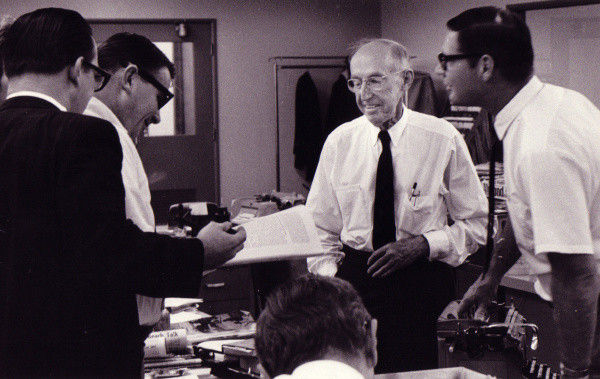

Comments